 USA
 Canada
What to check before you buy a used bulk tank
Size, the stainless inside, the cooling unit, the wash system and the paperwork: what to look at and what to ask before you buy a used bulk tank.
In this guide
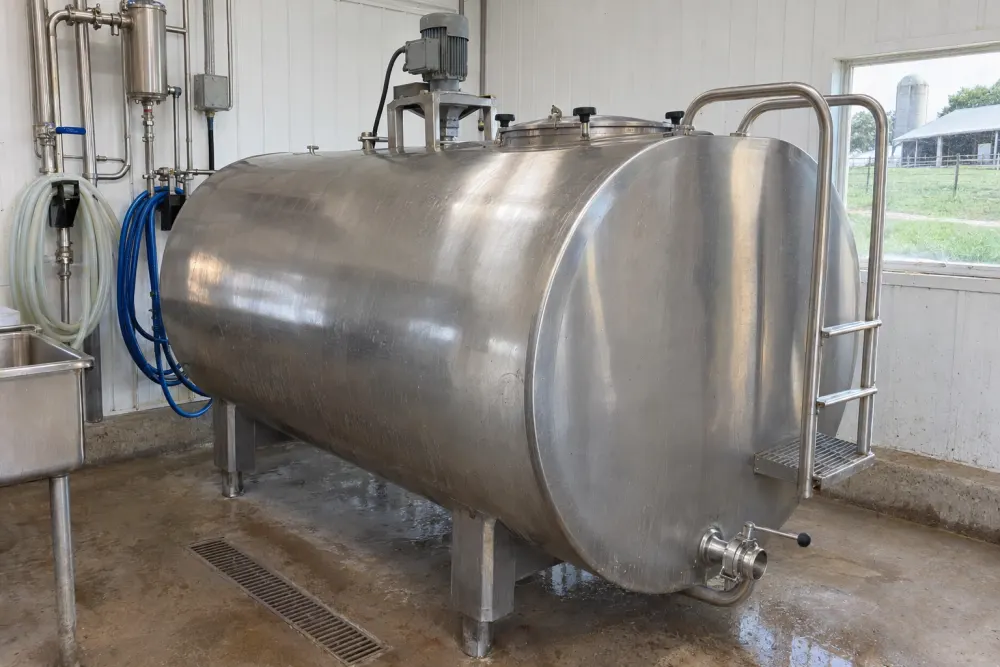
A good used bulk tank can serve a farm for many more years. A bad one costs you milk, a failed inspection or a repair bill bigger than the savings. Most of what matters can be checked in an hour with a flashlight, a few questions and a call to your milk inspector.
Start with the size and the space
Work out how much milk the tank has to hold between pickups, then leave room for growth and for a missed pickup in bad weather. A tank that is too small is a daily worry; one that is far too big can be harder to cool and wash properly with a small volume in it.
- Measure your milk house door, the ceiling height and the path the tank has to travel to get in.
- Check the floor drain and where the outlet valve will sit for the milk truck hose.
- Ask what electrical supply the tank and its cooling unit need, and whether your service can carry it.
Call your milk inspector first
Before you agree on a price, talk to your milk inspector or your processor's field rep. Rules for used tanks differ by province and by buyer. They can tell you whether the tank model is acceptable, whether it needs a new calibration chart after it is moved, and what temperature recording you need.
Look hard at the inside
The inside surface touches every drop of milk, so it is the part you cannot compromise on. Take a strong flashlight and look at every surface you can reach.
- No pitting, cracks or rough spots in the stainless, especially along welds and around the outlet.
- No dents or bulges in the inner liner, which can point to damage or a frozen tank.
- No milkstone or film that will not come off. It can hide damage and it holds bacteria.
- A clean, fresh smell. A sour smell can mean the wash system was not doing its job.
- The lid closes squarely and its gasket is soft and whole.
The cooling unit
The tank is only as good as the refrigeration behind it. Find out whether the compressor and condensing unit come with the tank, how old they are and when they were last serviced.
- Ask to see it run. If there is no milk in it, ask whether it can be run with water to show that it cools.
- Listen for knocking, rattling or a compressor that short-cycles on and off.
- Look for oil stains around fittings, which can mean a refrigerant leak.
- Ask which refrigerant it uses. Some older refrigerants are being phased out, which can make repairs harder to arrange and more expensive.
- If you use a plate cooler or heat recovery, check that the tank will work with them.
Agitator, wash system and controls
- The agitator turns smoothly and quietly, with no oil leaking from the gearbox.
- The wash arm or spray ball is all there, and the wash controller runs through a full cycle.
- The thermometer reads correctly against one you trust.
- The outlet valve opens and closes fully and does not drip.
- The legs are sound and can still be adjusted for leveling.
Paperwork to ask for
- The serial plate, readable and matching any calibration chart.
- The calibration chart and the dipstick, if it has one.
- Manuals for the tank, the cooling unit and the wash controller.
- Service records, and the name of whoever looked after it.
Questions to ask the seller
- Why are you selling it?
- Was it in use right up to when it came out of service? If not, how long has it sat, and where?
- Has it ever frozen, been dropped or been repaired inside?
- Did it pass its last inspection?
- Who will disconnect it, recover the refrigerant and load it?
Getting it out and home
Agree in writing who takes the tank out and when. The refrigerant should be recovered by a licensed refrigeration technician and the lines capped, never cut and vented. A bulk tank is awkward and easily dented, so read Moving and hauling big equipment before the day comes, and find a hauler in the Business Directory if you need one.
When you are ready, search bulk tanks for sale near your postal code.
Ready to look?
Search used dairy equipment from farmers across Canada, or post a Wanted ad and let sellers come to you.